Interweave Stadium
Music made visible, an architecture of intertwining Möbius strips that gives spatial sound and rhythm a continuous, physical form.
UNSW - Parametric Design and Digital Fabrication
BENV1012 Assessment 02 2026 - Luminocity 2026 Exhibition Model
Brief
BENV1012 Design Computing, UNSW Sydney. The task was to design the roof shell structure of a mid-scale sports or performance stadium, exploring how geometry, curvature, and patterning can create a visually compelling and architecturally resolved canopy form driven by parametric design. The shell was required to span over a seating bowl or playing field, providing weather protection and a sense of enclosure for spectators, while also expressing a clear structural and formal logic. Conceptual exploration of structural patterning such as ribbed, gridshell, or panelled systems, apertures and openings for light and ventilation, and the stadium's visual identity from the exterior were all considerations of the brief.
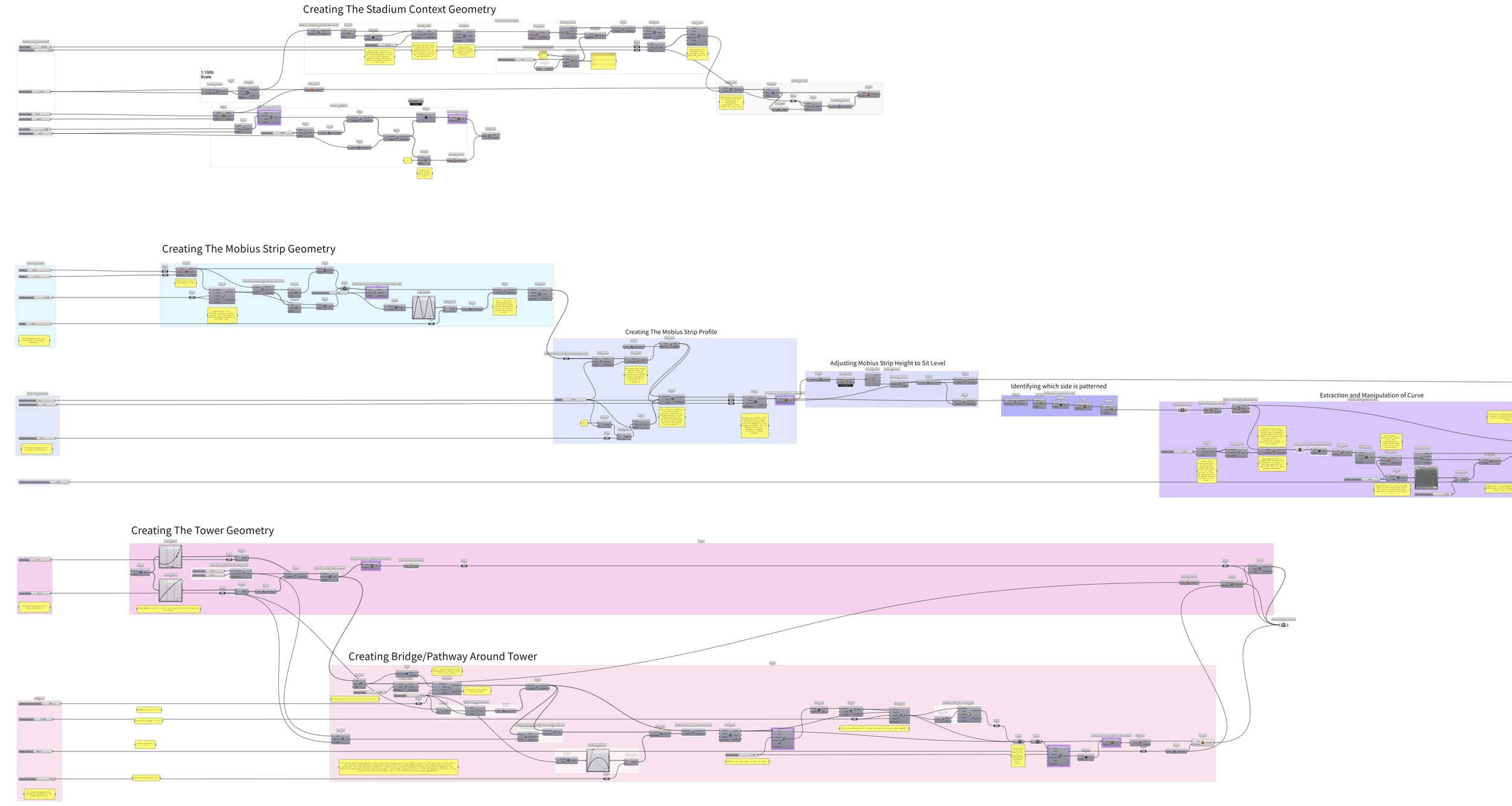
The design was developed as an adaptable digital 3D model in Rhino and Grasshopper, with iterative geometric variations generated in response to the brief. Students were encouraged to utilise any methods and plugins learned across the term. The Grasshopper script required full organisation and annotation, with blocks of code grouped, labelled, and commented to explain what each section does, why that approach was chosen, and how the parameters influence the geometry. All sliders controlling the model's parameters were to be named and located at the beginning of the script. Annotation was a graded component, expected to demonstrate understanding of parametric logic rather than simply describe what is visible on screen.
Deliverables included a poster showing the project name, a written project description covering design intention and process, six digital model variations generated from the same script by adjusting slider values with parameters shown for each, and three images of the final design. The physical prototype was fabricated primarily through 3D printing, no larger than 150x150x150mm.
Interweave Stadium
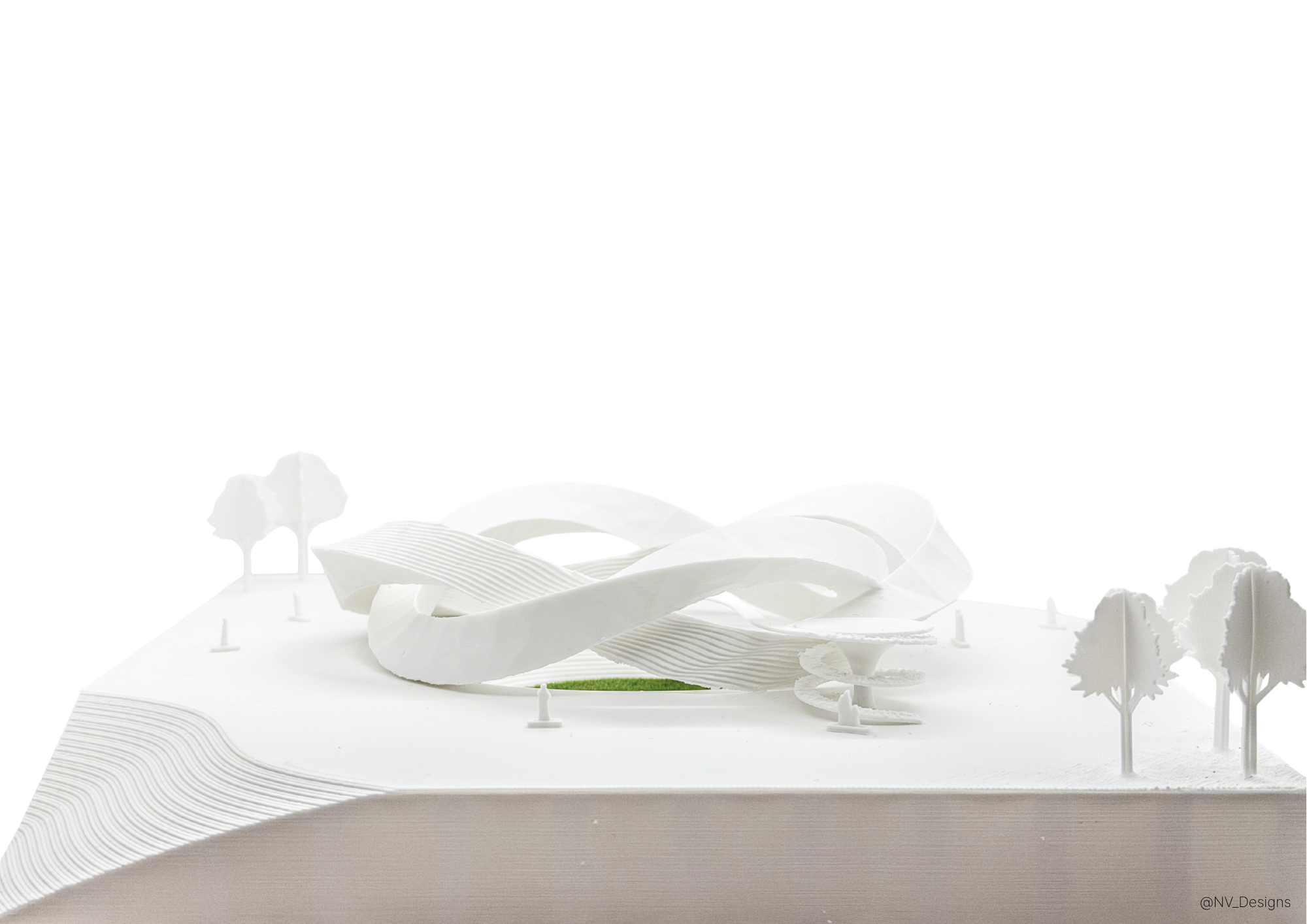
The design intent is rooted in the idea of music made visible, the notion that spatial sound and rhythm can be given form and held within architecture. Two intertwining Möbius strips make up the geometry, each a single continuous surface with no fixed inside or outside. The seamless quality of the form, and the way it lifts off a wrapping band of stepped seating, draws directly from Kazuyo Sejima, whose work treats structure as one continuous fluid surface rather than a stack of heavy parts.
The Grasshopper script starts by interpolating a curve through a series of points to set the looping path of each strip. That curve is divided into segments, and a perpendicular frame is placed at each division so a profile can sit square to the path. A polygon profile is then rotated progressively along the curve through a series of angles, which produces the half twist and lets each surface read as one uninterrupted Möbius band. The rotated profiles are lofted together into a continuous surface. Two strips were generated this way and intertwined at the centre of the form, where they meet to carry the roof as one unified component.
The patterned strip is applied through the surface's own UV coordinates. The surface is reparameterised to a clean 0 to 1 range, points are spread evenly across that range, and isocurves are drawn at each position, then trimmed and joined so the slit openings follow the twist of each strip. The stepped seating is generated directly into the surface through an amplitude and move sequence and offset to a set width, forming the amphitheatre steps that wrap the base.
The columns are built separately. A tapering radius is controlled by two graph mappers; circles are stacked up to a set tower height, and those circles are lofted and capped into a solid to form each column, with a spiralling curve arrayed around it to vary the profile as it rises. The assembly is mirrored for both column positions.
Applications Used:
Grasshopper (Script)
Rhino (3D Modelling)
D5 Render (Visualisation)
Bamboo Lab
3D Printer
Canva